Monday, August 10, 2009

On Shooting Dance, Part IV

Let's continue with my discussions and ruminations on my niche. There's a wall a dance photographer will hit and it looks like this: "What else should I do?"

First, you should not steal another photographer's material. Especially mine. It's astounds me, simply floors me how often I see a.) my photos elsewhere on the internet without proper attribution and b.) my material, my choreography in someone's frame.

Second, you should create your own material other photographers and dancers will want to steal.

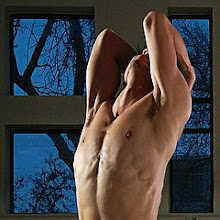
I prefer the second. I prefer to produce something gritty, something muddy, something unpredictable. Something beautiful. The above photo illustrates this point as part of the Studio 60 Project where the actual space is as much a part of the composition as the dancer, all it's quirks and ugly spots included. The lighting is hard, the dancer is turned in, the background not clean and easy. A former teacher of mine would say the following, "Why would you want to make that line?"

Because: this is my dance and this how I do it. I do not revere dance the same way the general public does. I used to be like that, revere the goddess in her pointe shoes, revere her training or her body, her mastery of the grueling technique. But she is just like any other person. She just happens to dance.

Technical mastery is an orphan, pretty lines by pretty dancers for pretty pictures are orphans. The true beauty in dance lies within the dancer and how it manifests into a line, a shape, a photograph. Something you'll want to steal.

Friday, July 31, 2009

On Shooting Dance, Part III

Light is such a cool thing. It's the primary tool in shaping and painting the frames we want to. Light comes in an array of colors, shapes and sizes that are just as important as a wide-angle or telephoto, shallow depth of field or stopped down to f/45.

When approaching a headshot the emphasis is upon how the face is lit, how the face is framed, how the eyes let the viewer in. A similar mandate happens in the theatre. When I worked on the stage production of Assassins as a spot-light operator, I chopped the light down such that from the torso up was lit as to place emphasis where the emotion was to be coming from leaving the extremities unlit.

Dancers on the other hand are a completely different ball game. They are a moving sculpture where words and emotion are conveyed throughout the entire body, nothing is left to chance. The challenge for the photographer is then how best to sculpt a dancer's body with light, drawing the emphasis where you want it, expressing both the mood of the dancer and photographer in 1/3000 of a second.

Monday, July 27, 2009

A Lack of Color

I always wonder what it would have been like with a pair of F3's on my shoulders and a bag filled with HP5 and filters.

Sunday, July 12, 2009

Nikon D700 - A Concise Review

Other sites, pages, blogs, etc. can bore you to death with all the technical jargon of this camera but I'll sum this thing up in a way that's meaningful to working photographers:

Pros: Isn't the D3
Cons: Isn't the D3

Hopefully you can read between the lines.

Saturday, July 4, 2009

Gimmick or Tool?

I can't decide. But the results this little lens pops out are decidedly fun and my clients seem to like them too.

Friday, May 15, 2009

On the Subject of HP5

HP5. What a film. Ilford HP5, smells great in 120 and 220. I sometimes wish I shot large format just so I could open up a huge sheet of silver halide and gelatin in 8x10. The tones are continuous and delicious. Push it and pull it all you want. And that sweet, sweet grain: not too much and not entirely absent.

I own a Nikon D700 which likely boasts the lowest numbers when it comes to luminance noise and the sensor on the camera produces very sharp images with so many values for each red, blue, or green setting as to make my head spin and possibly develop an aneurysm. Plus all these numbers can be develop to another set of values ad infinitum. I can counter some very bad screw-ups such as white balance and over-sharpening. All those number, all 14-bits of them are an impressive array to do battle with in Photoshop but getting those numbers to magically align the way HP5 does is near impossible.

I don't want to go out and understand how HP5 responds to each color, I don't care. It's not going to get me closer to my result to know which contrast curve I should pick out for each of the primary colors, I'd rather point my lens at something interesting instead of test charts. So it's great that a company like Nik has done all the dirty work for me.

Enter Silver Efex, a plug-in designed by guys who know how I think. Orange filter with low local contrast with response curves just like HP5 and noise/grain that isn't just a blanket spread of random black and white pixels? Oh, and push it a stop? Done and done. It's an amazing plug-in, coming to me at a time when I'm getting tired of glossy, over-sharpened images.

(still...happiness is an F3 loaded with a fresh roll of HP5)

Saturday, February 7, 2009

Kristina Baskett and the Creation of a Portrait

If anybody's followed my photography as closely as I have, you'll know I've had a huge soft spot for the Red Rocks. I was completely blown away by them the first time I watched from the student section and then completely addicted the first time I was on the floor behind the lens. Shooting the NCAA Finals is easily one of my favorite assignments of all time.

Enter Kristina Baskett, gymnast extraordinaire and budding photographer. Any time I had to go the Dumke center for a portrait session, Kristina was there soaking up every bit of information she could. On one shoot she served as a moving lightstand in lieu of a real one. What's truly ironic is that I've done portraits of many of the other gymnasts on the team but never Kristina. I decided to remedy that in September and just asked her if she wanted to get together and just have fun, I'd show her a few things about how I light and why I light and we'd get some awesome photos in the process.

If anybody's followed Kristina's floor routine over the last few years you'll know she always tosses in this break-dancing/capoeira move. And if anybody knows how much I love shooting dramatic portraits wide-angle then you'll know the image was 95% composed by the time I set up my lights.